Owning the Sun by Alexander Zaitchik
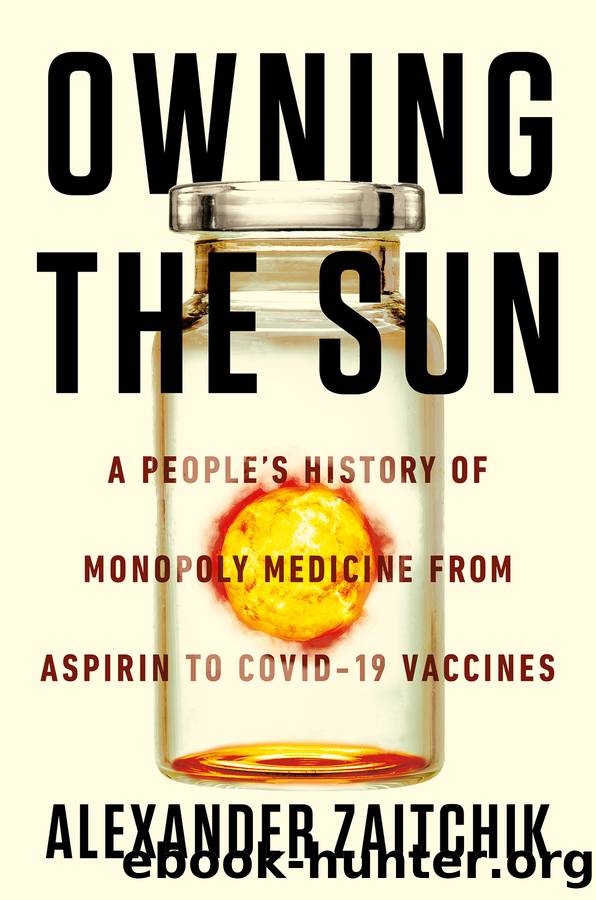
Author:Alexander Zaitchik
Language: eng
Format: epub
Publisher: Catapult
Published: 2022-01-07T00:00:00+00:00
Harold Luhnow couldnât claim ignorance of the Austrian School position on patents. The Readerâs Digest edition of Serfdom included Hayekâs general views on the subjectâillustrated by his praise of the New Deal TNEC investigationâand concluded with a warning that âgreat danger lies in the policies of two powerful groups, organized capital and organized labor, which support the monopolistic organization of industry.â
For American conservatives like Luhnow, the Austrian Schoolâs focus on âorganized capitalâ was disposable. A product of European trauma, maybe, a bias based on an understandable obsession with the role of industry in Imperial and Nazi Germany. But big business was not a threat in America. The political destination of Luhnow and his ilk was not nineteenth-century Hollandâwhich rejected patents in favor of a âfree trade in inventionsââbut a second Gilded Age where corporate titans not only had a God-given right to patents but could do with them what they goddamn pleased. The conservative revival they envisioned had no place for valorizing the TNEC, and certainly not the antitrust crusade of Thurman Arnold, who continued to haunt corporate Americaâs nightmares, a pen in one hand, the consent decree in the other.
Months before the Free Market Study was to begin, an unexpected event released the tension between classical liberal theory and modern American conservatism in Luhnowâs favor. In June 1946, Henry Simons committed likely suicide by overdosing on barbiturates. A key figure in the development of monetarism, and generally considered the most brilliant of the Chicago conservatives, Simons was the Chicago groupâs antitrust conscience. He did not apologize for advocating the use of state power to maintain an even playing field as the precondition of a free market, and once described the Federal Trade Commission as the most important government agency. Heterodox but consistent, he hated Hoover as much as Roosevelt, and oligopolies and monopolies above all.
Luhnow knew Simonsâs views and understood the respect he commanded from the groupâs members, many of whom had been influenced by Simonsâs strict 1934 tract, A Positive Program for Laissez Faire.
Following Simonsâs death, Luhnow asked his friend and fellow Chicago economist Aaron Director to take over running the Free Market Study. In his book Goliath, Matt Stoller writes that Luhnow had been concerned with Simonsâs influence and hard-line position on monopoly, and believed Director to be âfar more ideologically malleable.â
For the next three years, not much changed, and Director maintained the Simons-Hayek line on monopoly and corporate giantism, which aligned with the views he expressed in an address to the 1947 meeting in Mont Pelerin. Current antitrust laws, Director had said, should be seen as âstopgap measuresâ on the way to more radical restrictions on corporate power. These included limits to the scope of corporate activity as well as âperhaps a direct limitation of the size of corporate enterprise.â Director was equally clear in his condemnation of patents as the handmaidens of monopoly and called for dramatic reductions in their terms. Simons would have been proud.
Only when funding for the Free Market Study was set to expire, in late 1950, did Luhnow begin to express himself on the matter.
Download
This site does not store any files on its server. We only index and link to content provided by other sites. Please contact the content providers to delete copyright contents if any and email us, we'll remove relevant links or contents immediately.
Periodization Training for Sports by Tudor Bompa(8278)
Why We Sleep: Unlocking the Power of Sleep and Dreams by Matthew Walker(6729)
Paper Towns by Green John(5196)
The Immortal Life of Henrietta Lacks by Rebecca Skloot(4593)
The Sports Rules Book by Human Kinetics(4398)
Dynamic Alignment Through Imagery by Eric Franklin(4223)
ACSM's Complete Guide to Fitness & Health by ACSM(4062)
Kaplan MCAT Organic Chemistry Review: Created for MCAT 2015 (Kaplan Test Prep) by Kaplan(4015)
Introduction to Kinesiology by Shirl J. Hoffman(3778)
Livewired by David Eagleman(3778)
The Death of the Heart by Elizabeth Bowen(3626)
The River of Consciousness by Oliver Sacks(3607)
Alchemy and Alchemists by C. J. S. Thompson(3526)
Bad Pharma by Ben Goldacre(3429)
Descartes' Error by Antonio Damasio(3283)
The Emperor of All Maladies: A Biography of Cancer by Siddhartha Mukherjee(3166)
The Gene: An Intimate History by Siddhartha Mukherjee(3100)
The Fate of Rome: Climate, Disease, and the End of an Empire (The Princeton History of the Ancient World) by Kyle Harper(3069)
Kaplan MCAT Behavioral Sciences Review: Created for MCAT 2015 (Kaplan Test Prep) by Kaplan(2988)
